TWO:Miserably as Arnold had passed the winter in his camp, as spring approached he again planted his batteries above Quebec, but produced so little effect that Carleton lay still in expectation of his reinforcements on the breaking up of the river. On the 1st of April General Wooster arrived, and took the command, much to the disgust of Arnold, who was sent to command a detachment at[224] Montreal. On the 1st of May, General Thomas, who was to be supreme in command, arrived, and found the forces amounting to about two thousand men. The river was now opening; and on the 6th of May three English ships had made their way up to Quebec, full of troops. Two companies of the 29th Regiment and one hundred marines were immediately landed amid the rejoicings of the inhabitants; and General Carleton gave instant orders to issue forth and attack the American lines. But General Thomas, conscious that, so far from being able to take Quebec, he should be himself taken, unless he decamped with all haste, was already on the move. General Carleton pursued him vigorously, and the retreat of the Americans became a regular rout. They threw themselves into boats at the Three Rivers, leaving behind them all their artillery and stores, as well as the sick, who were numerous, the smallpox having broken out amongst them. Thomas managed to reach Fort Chambly and St. John's on the Sorel; but there he died, having taken the smallpox.
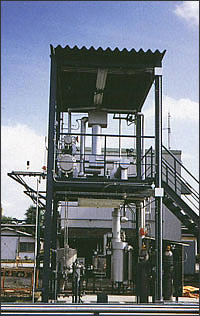
Great attention is recently being paid to global environmental issues, and it is now conceivable that companies will need to treat used solvents themselves. In consideration of this kind of social issue, we have developed a “membrane separation type solvent dehydration system,” which uses a polyimide membrane with superior dehydration properties developed by Ube Industries, Ltd. in combination with our own distillation and concentration technology that has resulted in solvents being more easily recovered.
THREE:
- 1Under the distillation system, even in case of azeotropic solvent compositions, this system which remove water vapor by the polyimide membrane will easily dehydrate.
- 2In comparison with the distillation system, it significantly saves on use of steam.
- 3Dehydration can be performed through merely supplying evaporated vapor to the membrane module and maintaining the differential pressure between the permeable side and the impermeable side.
- 4Solvent purity of 99.9% or more can be achieved by carrying out dehydration with a polyimide membrane only.
- 5The polyimide membrane has superior heat and solvent resistance. Therefore, the vapor permeation system reduces contamination of the membrane and thus extends its life.
THREE:[See larger version]
The aromatic polyimide membrane is highly permeable to water vapor but less permeable to vapors of organic compounds such as alcohol etc.
THREE:The first thing which occupied the Government on the opening of the year 1779 were the trials of Keppel and Palliser. That of Keppel commenced on the 7th of January, and lasted till the 11th of February. The Court consisted of five admirals and eight captains; Sir Thomas Pye, Admiral of the White, being president. Keppel was acquitted, and pronounced to have behaved like a brave and experienced officer, and to have rendered essential service to the State. This sentence occasioned a wonderful rejoicing in the City, where Keppel's political principles prevailed. The portico of the Mansion House was illuminated two successive nights, and there were general illuminations throughout London and Westminster. It had been well had the demonstration ended there; but the mob took the opportunity of the guard which had been stationed before the house of Palliser in Pall Mall being withdrawn at midnight to smash in his windows, burst in the doors, and destroy his furniture. The work of destruction once begun was soon extended. The mob demolished the windows of Lord North and Lord George Germaine, as well as of the Admiralty, Government being looked upon as the real enemies of Keppel and accessories of Palliser. The next day, the 12th of February, Parliament and the City Corporation gave the most unmistakable sanction to these proceedings. Both Houses of Parliament voted thanks to Keppel: the Lords unanimously, the Commons with only one dissenting voice. The Court of Common Council not only voted thanks to Keppel, but presented him with the freedom of the City in a box of heart of oak, richly ornamented, and the City was more brilliantly illuminated than before, the Monument being decked out with coloured lamps.Accordingly, the Duke found himself alone in his opposition to the plan of an armed intervention in Spain. It was at first proposed that all the Allies should unite in this; but it was ultimately agreed that a proc¨¨s verbal should be jointly adopted, in which the King of Spain and his family should be declared to be under the protection of Europe, and Spain threatened with a terrible vengeance if any injury were done to them. This proc¨¨s verbal was addressed to the head of the Spanish Government, with an explanation of the reasons for its adoption. The Duke was disappointed and mortified at the obstinate self-will of the crowned despots. He had gone to Verona in the hope that they would at all events be open to arguments in favour of peace; he found them bent on such a course as would render its preservation impossible. When the Ministers reduced their ideas to a definite shape, the incidents which they agreed to accept as leading necessarily to war appeared to him fallacious in the extreme. They were these:¡ªFirst, an armed attack by Spain upon France[235]. Second, any personal outrage offered to Ferdinand VII., or to any member of the Spanish royal family. Third, an act of the Spanish legislature dethroning the king, or interfering in any way with the right of succession. Austria, Prussia, and Russia accepted the conditions readily, adhering, at the same time, to the substance of the notes which they had previously put in.
- 1 Recovery of the detergent solvent Recovery of the cleaning solvent such as electronic parts industry, precision instrument industry.
- 2Solvent recovery and the refinement Solvent recovery and the refinement such as chemical industry, an industry of medical supplies, food industry, the fermentation industry.
THREE:Mr. Peel urged that it is dangerous to touch time-honoured institutions in an ancient monarchy like this, if the Dissenters did not feel the tests as a grievance; if they did, it would be a very strong argument for a change. "But," he asked, "are the grievances now brought forward in Parliament really felt as such by the Dissenters out of doors? So far from it, there were only six petitions presented on the subject from 1816 to 1827. The petitions of last year were evidently got up for a political purpose." He quoted from a speech of Mr. Canning's, delivered, in 1825, on the Catholic Relief Bill, in which he said, "This Bill does not tend to equalise all the religions in the State, but to equalise all the Dissenting sects of England. I am, and this Bill is, for a predominant church, and I would not, even in appearance, meddle with the laws which secure that predominance to the Church of England. What is the state of the Protestant Dissenters? It is that they labour under no practical grievances on account of this difference with the Established Church; that they sit with us in this House, and share our counsels; that they are admissible into the highest offices of State, and often hold them. Such is the operation of the Test and Corporation Acts, as mitigated by the Annual Indemnity Act; this much, and no more, I contend, the Catholics should enjoy." With regard to Scotland Mr. Peel appealed to the facts that from that country there was not one solitary petition; that there was not any military or naval office or command from which Scotsmen were shut out; that, so far from being excluded from the higher offices of Government, out of the fourteen members who composed the Cabinet, three¡ªLord Aberdeen, Lord Melville, and Mr. Grant¡ªwere Scotsmen and good Presbyterians. Even in England the shutting out, he said, was merely nominal. A Protestant Dissenter had been Lord Mayor of London the year before. The Acts had practically gone into desuetude, and the existing law gave merely a nominal preponderance to the Established Church, which it was admitted on all hands it should possess.
Acetone, ethanol, methyl ethyl ketone, butanol, isopropyl alcohol, ethyl acetate, methyl isobutyl ketone, others (including hexane and toluene).
